

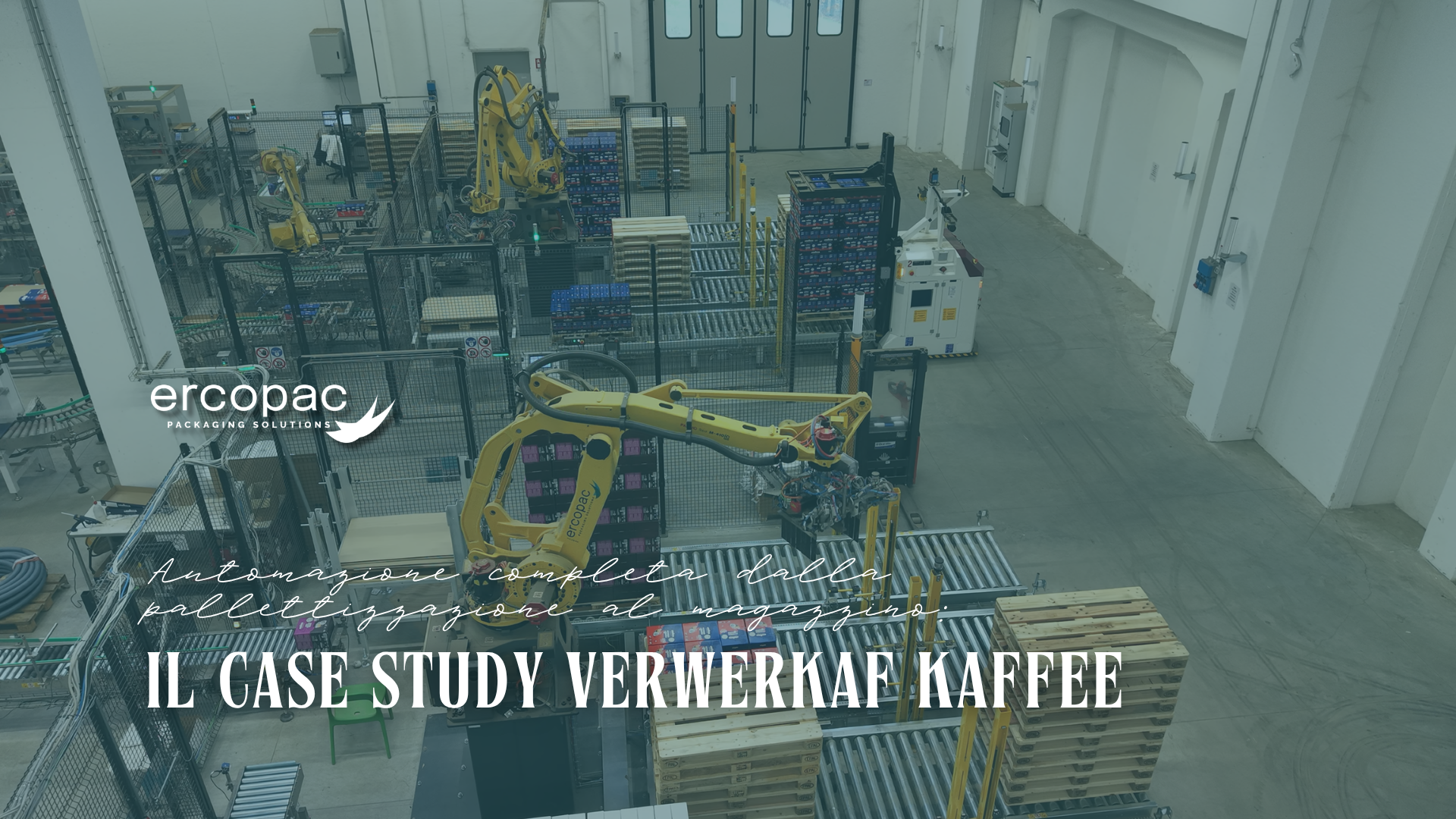
In the coffee industry, which is characterized by high production volumes and an increasing variety of packaging formats, theefficiency of end-of-line operations is a strategic factor in ensuring production continuity, cost reduction and product quality. In this context, end-of-line automation, robotic palletizing and automated intralogistics assume a central role in process optimization.
To meet these needs, Verwerkaf Kaffee, a company specializing in decaffeination and coffee packaging based in Noceto, in the province of Parma, has chosen Ercopac and Tecnoferrari for the realization of a complete palletizing plant and automated internal logistics.
The developed solution covers all operational stages from palletizing to warehouse storage, integrating advanced robotics and AGV shuttles to ensure maximum efficiency and operational flexibility.
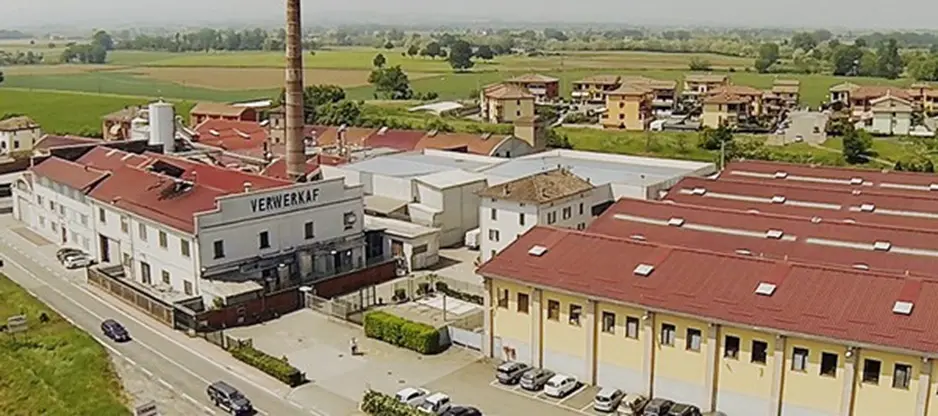
In the coffee industry, the end of the line is increasingly strategic
In the coffee industry, end-of-line management directly affects plant productivity and continuity of operations. When volumes increase and packaging formats multiply, it becomes essential to adopt solutions that can automate palletizing and internal handling in a coordinated manner.
The project created for Verwerkaf Kaffee was born from this very need: to integrate end-of-line and intralogistics into a single automated system capable of accompanying the product all the way to the warehouse.
Two robotic palletizing islands for five production lines
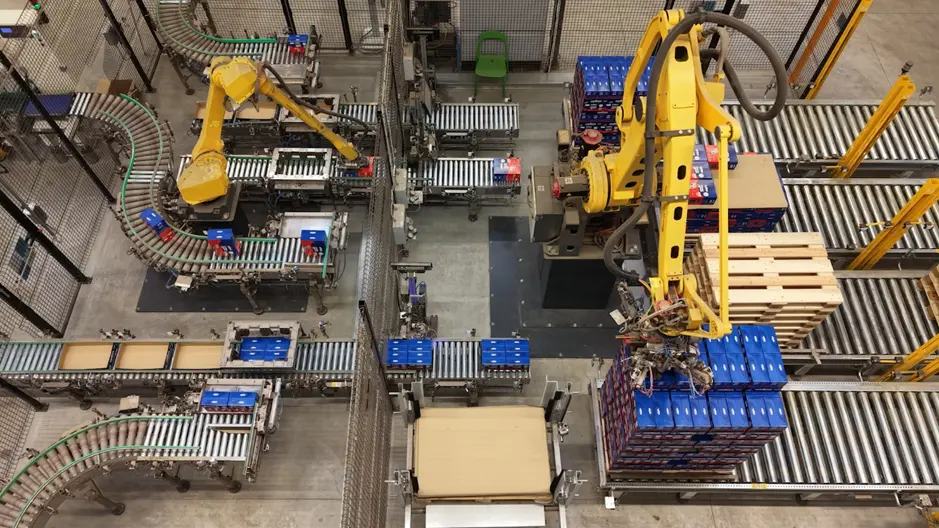
At the heart of the plant are two robotic row palletizing systems designed to handle a total of five production lines.
This configuration allows the end of the line to be automated in a structured way and to meet the different operational needs of the plant.
From handling empty pallets to transporting finished pallets to the warehouse, the system was developed to ensure business continuity and fully automated management of internal logistics flows.
First palletizing island: boxes and trays
The first palletizing island is equipped with a multi-socket gripper and integrates a dedicated robot for automatic preparation and filling of trays via suction table.
This means that the line not only receives product ready for palletizing, but also handles a preparatory step that would normally require a separate step. This reduces manual activities, standardizes preparation and keeps cell feeding more regular.
The configuration enables efficient management:
- Bulk boxes from production lines
- Trays prepared and filled automatically
Overall, this island serves three production lines, offering flexibility in handling different formats and configurations.
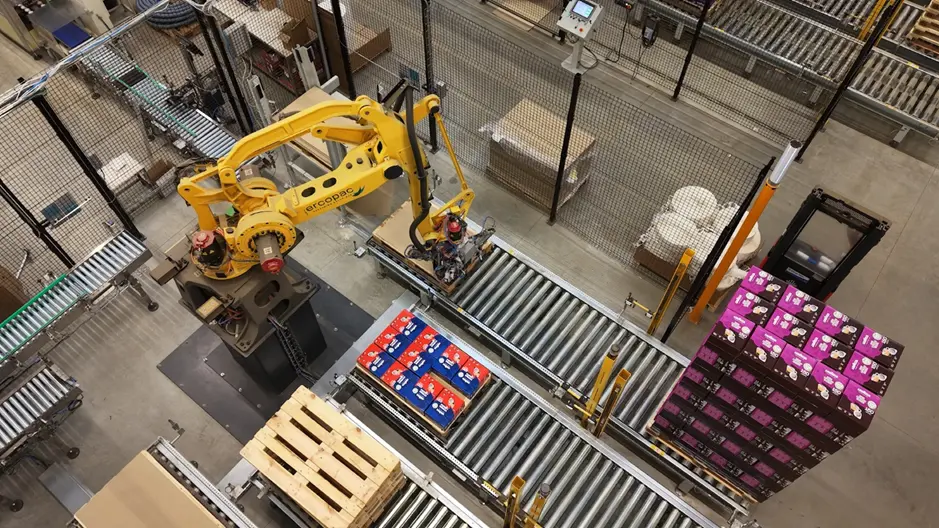
Second palletizing island: continuity and repeatability
The second island is dedicated to two bulk box production lines.
Here the main objective is to ensure cycle continuity and repeatability over time. In fact, the use of robotic row systems makes it possible to keep the operating sequence constant even on sustained production rates, with clear advantages in terms of handling precision and process stability.
Automation intervenes not only to speed up, but also to reduce operational variability: less dependence on manual intervention, less discontinuity, greater reliability throughout the work shift.
The decisive step: from palletization to in-house logistics
Once palletizing is completed, the critical point becomes transferring the pallet without creating congestion or loss of time between production and warehouse.
Therefore, the project integrates AGV shuttles equipped with a presser, which are in charge of automatically handling all major internal handling operations:
- Handling of raw materials
- Loading empty pallets into palletizing stations
- Picking up finished pallets from the lines
- Transportation to banding islands and to the warehouse
- Storage management in dedicated areas
The presence of the press is not a minor detail: it helps maintain load stability during handling, a key aspect when you want to automate the flow without introducing criticality downstream, and it allows you to achieve higher production speeds.
The result is smoother internal logistics, with less traffic, fewer manual interventions and greater business continuity.
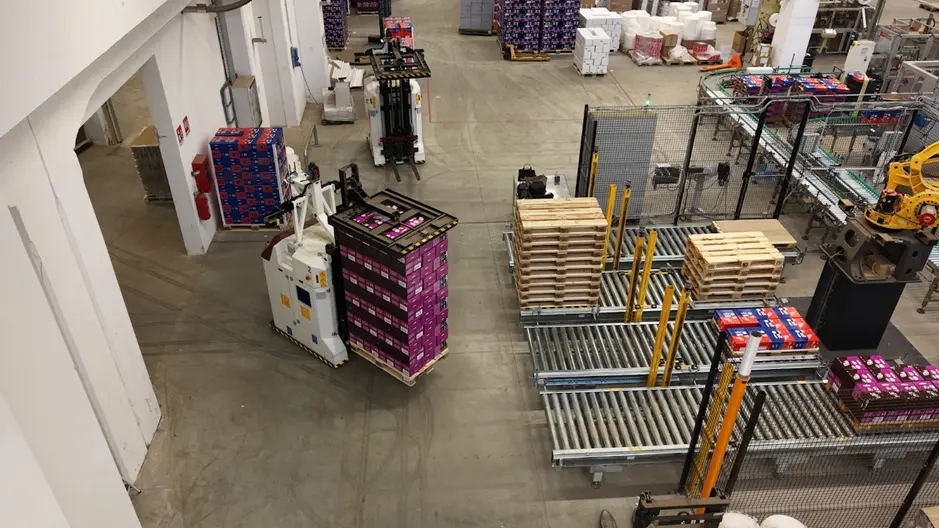
Why this plant really works
The project carried out for Verwerkaf Kaffee represents a concrete case of integration between end-of-line and intralogistics.
But the real strength of the facility lies in the balance between its parts.
The two palletizing islands work in parallel on different requirements. Automatic tray preparation eliminates an operational step that could slow down the flow.
AGV shuttles connect production to the warehouse without interrupting the continuity of the process.
In other words, it is not simply a matter of automating individual operations, but of designing a system in which each stage supports the next. It is this overall direction that enables:
- High productivity
- Flexibility in format management
- Reduction in operating costs
- Increased safety for operators
- Traceability of logistics flows
Watch the video of the plant in operation: https://www.youtube.com/watch?v=xQt12m-LLEc
A concrete case of automation for the coffee sector
The project developed for Verwerkaf Kaffee shows how a complete plant, from robotic palletizing to warehousing, can effectively meet the needs of the coffee industry.
The integration between two robotic palletizing islands, automatic tray preparation, and AGV shuttles makes this case study aconcrete application of industrial automation geared toward efficiency, production continuity, and automated internal logistics management .
Want to find out how to automate your end-of-line and optimize internal logistics?
Contact the Ercopac team to analyze your plant’s needs and develop a solution tailored to your production.