

At the end of the line, pallet wrapping is not an ancillary step. It is where load stability, transport safety, film consumption, and ultimately the efficiency of the entire plant are decided.
Choosing the right industrial wrapper means avoiding waste, reducing downtime and ensuring operational continuity.
The Ercopac range consists of three main solutions-Spider S, Spider C, and Spider R-which are joined by Heron as a complementary metti-top system.
The main criterion guiding the choice is the required production speed or capacity: based on the line cadence, the most suitable model is identified, starting from low-productivity solutions such as Spider S to high-speed robotic models such as Spider R.
The difference is not just technological, but design: layout, required throughput, type of load, and degree of automation directly affect the final configuration.
Cartesian robot or anthropomorphic robot: the first real crossroads
The first distinction concerns the architecture of the system. Spider S and Spider C are bundling systems with a Cartesian robot. Spider R, on the other hand, uses an anthropomorphic robot.
The Cartesian robot is generally chosen where space is tight or for additions to existing systems, where compactness and structural simplicity are a real advantage.
The anthropomorphic robot, on the other hand, is suitable for high speed and greenfield plants, where the required throughput is high and the layout can be designed around the wrapping system from the start.
It is not a matter of “better or worse” choice, but of consistency between required speed, available space, and system configuration.
Spider S: basic solution for low cadence lines
Spider S is the entry model in the range, designed for lines with low production capacity and for companies looking for a reliable, simple and investment-competitive solution.
It shares with the other Spider models the ability to handle:
- Half pallet 600×800
- Europallet 800×1200
- Industrial pallet 1000×1200
As well as the ability to process bottles, bricks, cans, paper rolls and other types of products, with side wrapping, dustproof and water-resistant configurations.
What characterizes it is not so much its technical equipment-common to the range-as its positioning as a low-cadence solution designed for plants that require operational reliability and cost containment.
It is suitable for plants that do not require high speeds but focus on load stability, management simplicity and low initial investment.
Spider C: high productivity and configurable modularity
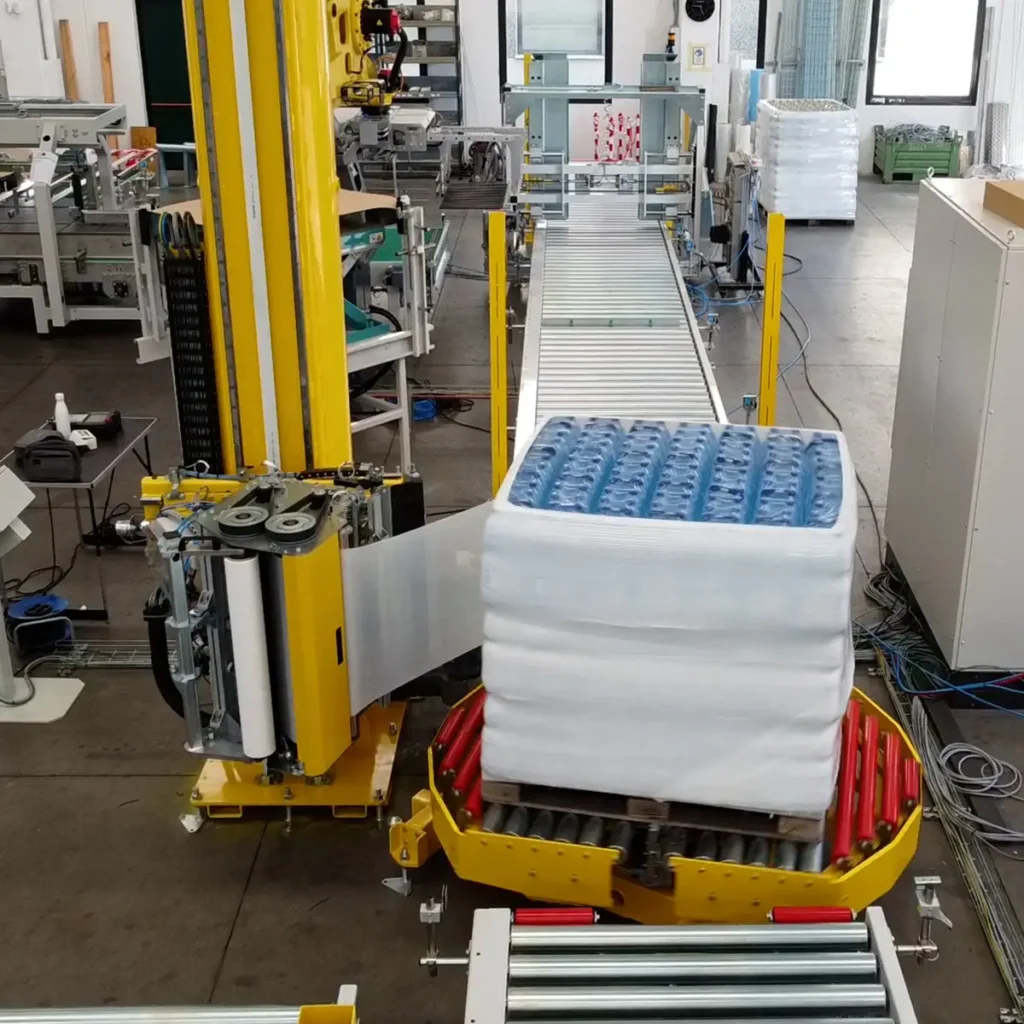
Spider C is a column wrapper with Cartesian architecture, designed for lines with production capacities up to 130 pallets/hour.
Compared with the basic model, it represents a more high-performance solution while maintaining the compact structure typical of Cartesian systems.
The range includes three configurations that can be adapted to the specific needs of the plant. Depending on the required speed, the system can be equipped with either an idle or motorized press, so as to ensure product stability during the wrapping cycle even at higher rates.
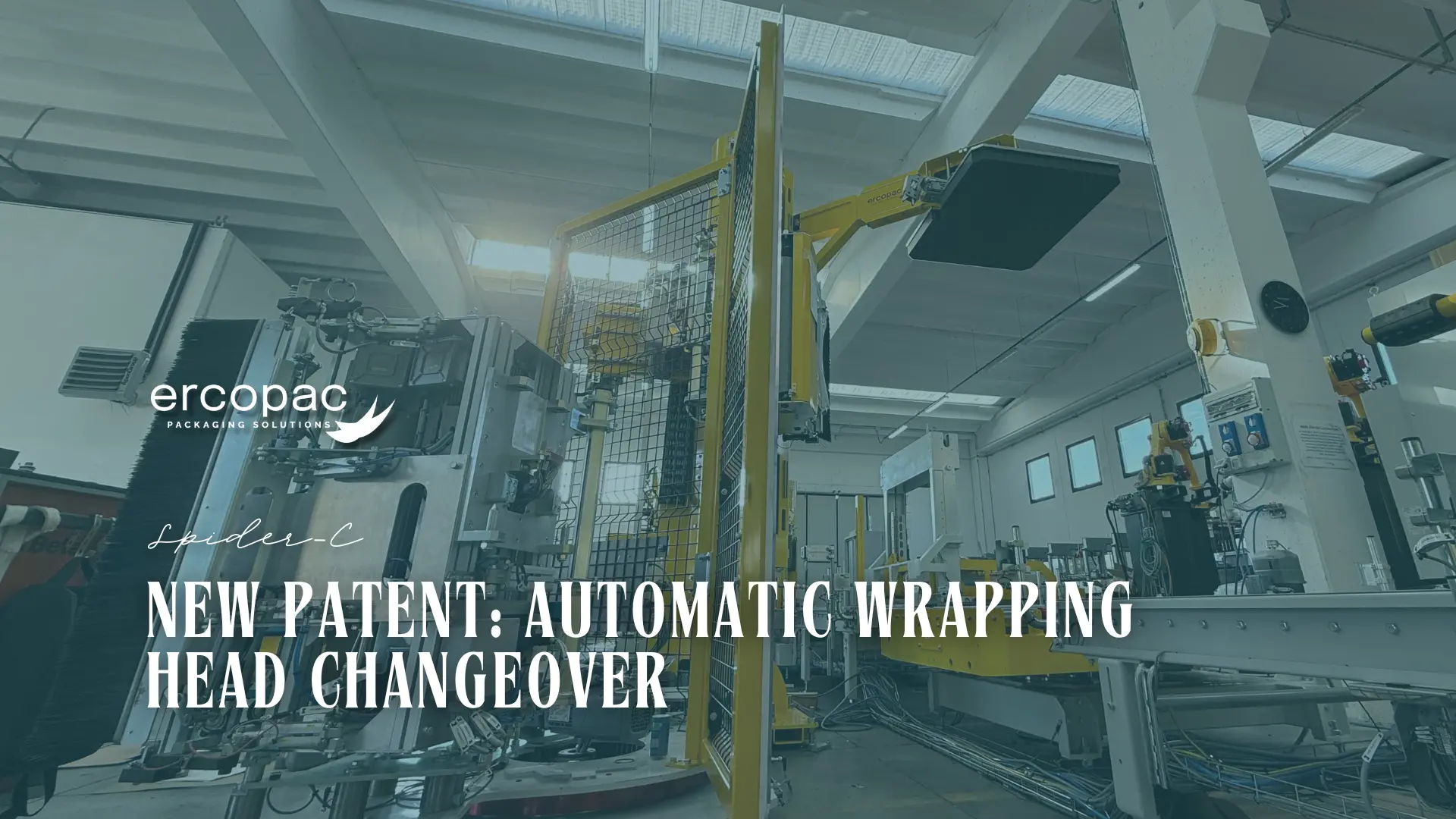
A distinctive feature is the automatic head changing system built into the column models. The mechanism involves a rotating assembly with two parking spaces that rotate 180° to allow for changing. The system is designed so that the head cannot fall off during operation, even in the event of software or operator error, increasing the overall level of safety.
The rotary table is driven by toothed belt and does not require periodic maintenance. It is connected to the press by an integrated mechanical axis, ensuring correct phasing between table and press under any operating condition.
In addition, the use of a single motor for table and press rotation movements helps reduce energy consumption, while the absence of motors at the top simplifies maintenance operations without the need for platforms or mezzanines.
Spider R: high performance, flexibility and fuel economy
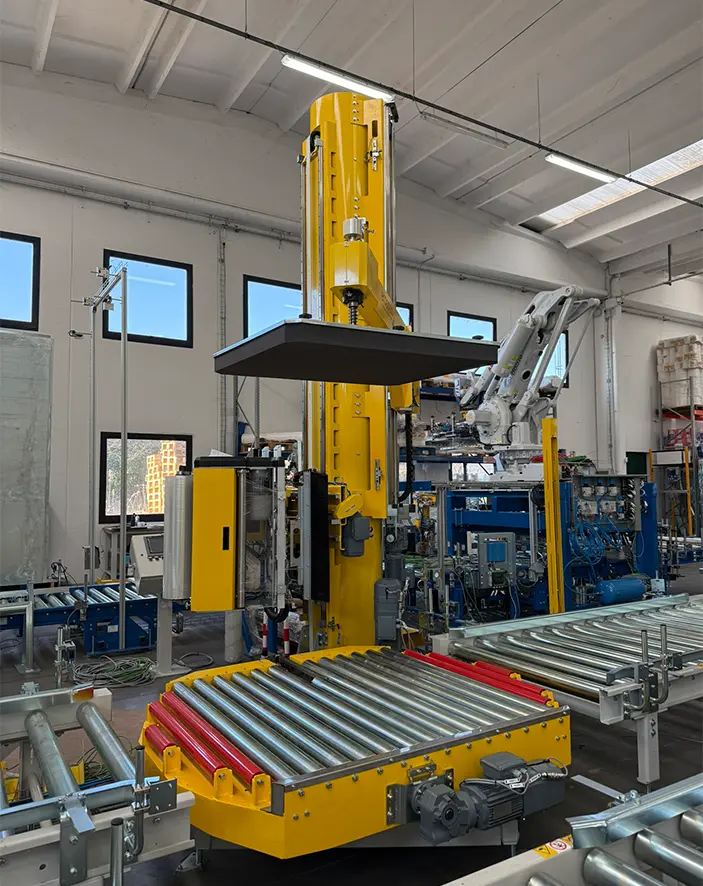
Spider R represents the anthropomorphic robot solution designed for high capacity lines up to 200 pallets/hour.
Automatic head change takes place in 25 seconds, ensuring operational continuity even under intensive cycles or frequent format changes.
The robotic architecture allows for greater freedom of movement than Cartesian systems, making the system particularly suitable for greenfield facilities or complex configurations where layout flexibility is a determining factor.
In addition to productivity, one of the main benefits of the robot is reduced energy consumption. The optimized kinematics of the anthropomorphic arm allows more efficient and targeted movements, avoiding continuously rotating mechanical masses typical of traditional systems. This results in a lower energy impact, especially on high cadence lines.
Thus, Spider R is suitable for contexts where high performance, operational flexibility and consumption optimization must coexist.
Heron: metti-top system for production continuity and material optimization
Heron: metti-top system for production continuity and material optimization
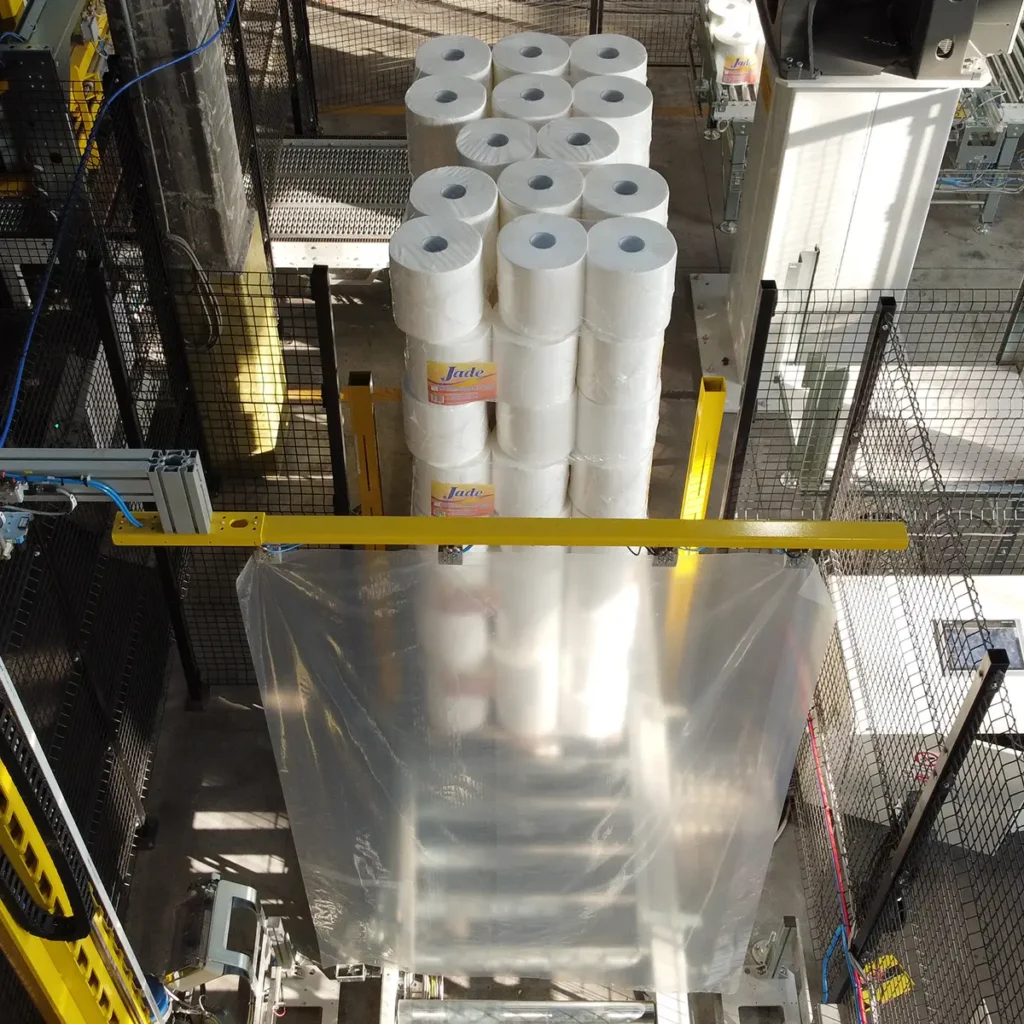
Heron is not an alternative to Spider systems, but a complementary metti-top system designed for automatic application of the pallet top cover sheet.
Key features include:
- Automatic reel carriage change (patent pending)
- Non-stop production during coil change
- Elimination of electric hoist and no suspended loads
An additional advantage is the ability to use top films up to 25 μ, which has a direct impact on both cost savings and reduction of plastic material use.
The production capacity is up to 210 pallets/hour.
Heron is installed in conjunction with Spider C and Spider R models, which, thanks to the presence of the presser, ensure the stability of the top sheet during the cycle.
Summary orientation table
Spider S: low cost, low maintenance, minimal need for intervention
Spider C: high productivity with Cartesian architecture and modular configuration
Spider R: maximum productivity, operational flexibility and reduced consumption thanks to anthropomorphic robot
Heron: superior pallet protection and continuity during reel change
All models handle the main pallet types, products and wrapping configurations.
The correct choice depends mainly on the required production capacity, available space and the level of automation of the plant.
At the end of the line, wrapping is not just wrapping: it is stability, safety, controlled consumption and production continuity.
The Spider range and the Heron system make it possible to build a solution consistent with the actual needs of the plant, avoiding oversizing or structural limitations.
Technical evaluation remains key: each facility has different constraints, goals, and priorities.