

Since August 12, 2026, the European Packaging and Packaging Waste Regulation (PPWR, EU
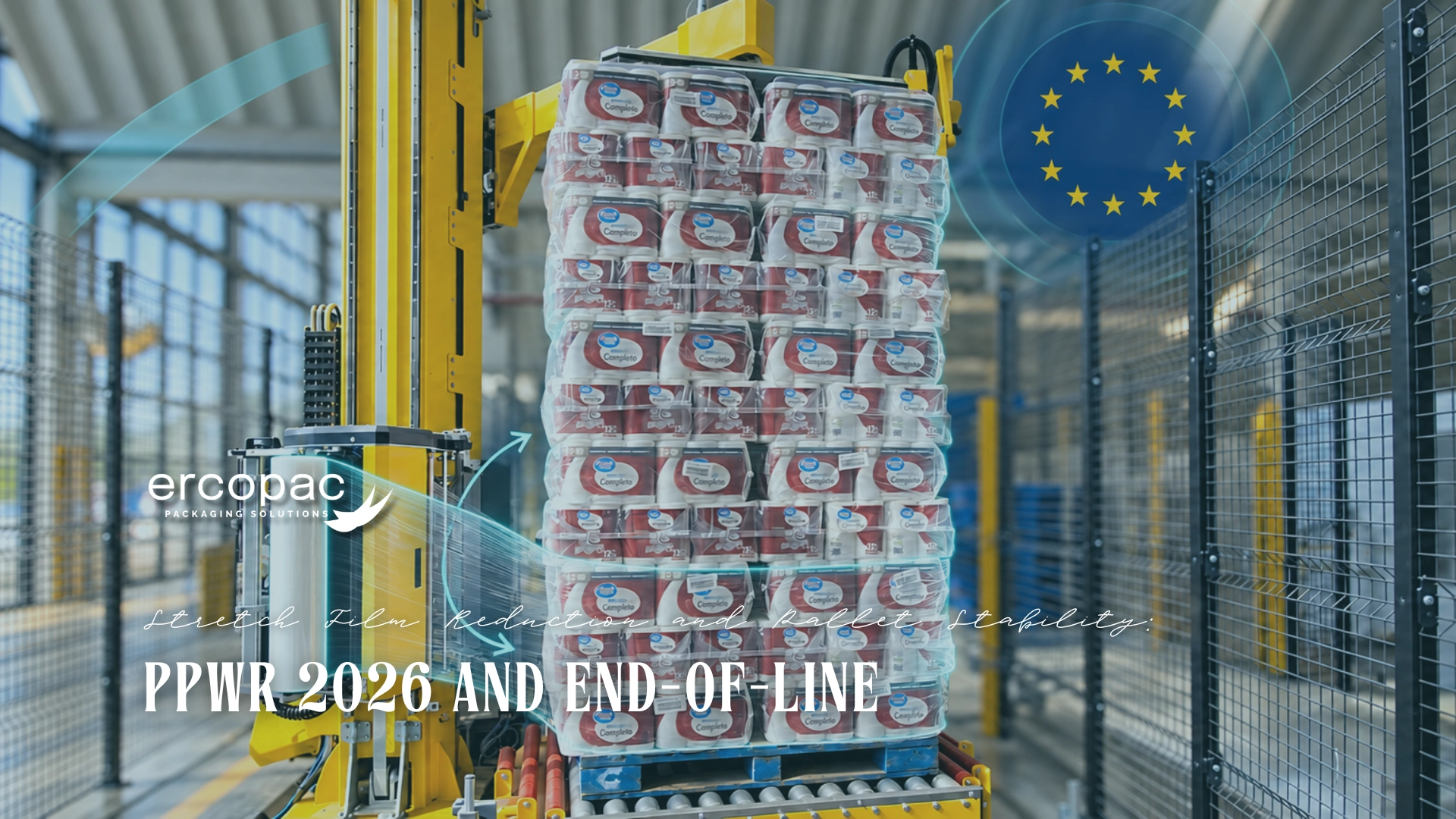
Regulation 2025/40) has been fully applicable. For many manufacturing companies, its impact on end of line operations is still underestimated. Attention goes to primary packaging, packs and labels, while pallet stretch film—the film used to wrap unit loads—is overlooked. It is tertiary packaging in its own right and is subject to the same source minimization requirements.
The question facing many production and supply chain managers seems simple: how can I reduce plastic without compromising load stability? The answer is less straightforward than it appears, and the most common mistake is to tackle it in the wrong way.
What the PPWR requires for tertiary packaging
The PPWR introduces obligations that directly affect companies that produce and use industrial packaging. Three are particularly relevant to those managing end of line operations.
First, source minimization. The regulation requires a reduction in the weight and volume of packaging materials, the elimination of unnecessary empty space, and evidence that every gram of material serves a justified technical purpose. In pallet wrapping, this means optimizing stretch film consumption, rather than merely claiming to have done so.
Second, the Declaration of Conformity (DoC). Every item of primary, secondary and tertiary packaging placed on the market must be accompanied by a formal declaration confirming compliance with PPWR requirements, including chemical limits on PFAS and heavy metals.
Third, Extended Producer Responsibility (EPR). For companies selling in multiple European countries, the PPWR introduces registration and contribution requirements under the EPR schemes of each country where products are placed on the market. Costs and administrative obligations rise in proportion to the volume of packaging used.
All three point in the same direction: use less film, use it more effectively, and be able to prove it with data.
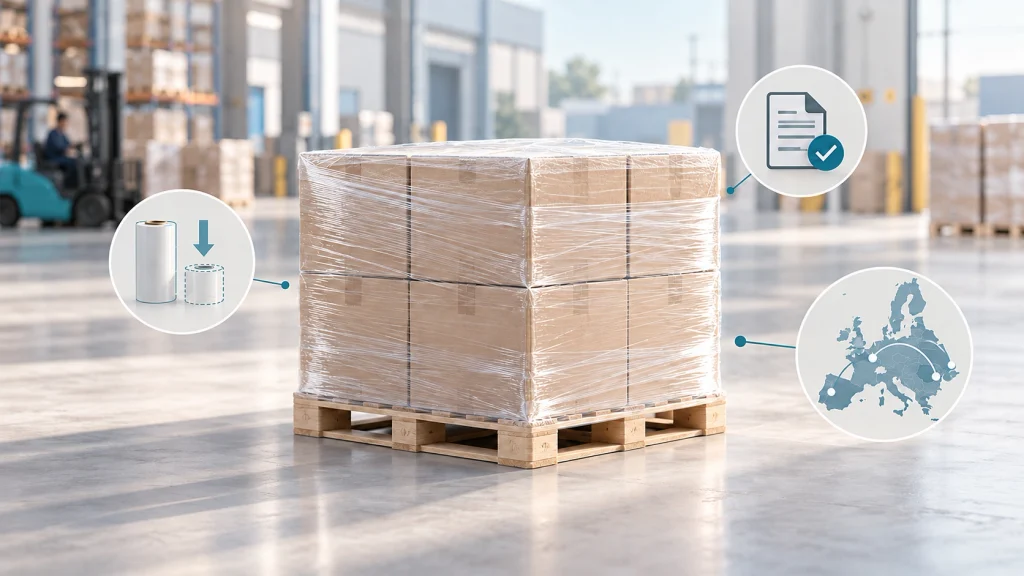
The most common mistake Reducing plastic in the wrong way
Faced with a requirement to reduce film consumption, the immediate reaction is often to lower the wrapping tension or reduce the number of wraps. It is a quick solution, requires no investment and produces a measurable reduction in material use.
The problem is that it does not work. A pallet wrapped with insufficient tension or too few wraps loses structural stability. The load shifts during transport, products become deformed, cartons are crushed and layers come apart. The result is not a saving: it is damage.
There is also an environmental paradox that is rarely considered. The carbon impact of a damaged product that must be discarded or reworked is estimated to be up to 30 times greater than that of the stretch film needed to protect it. Saving film only to send damaged products to retailers is not a sustainable choice.
True stretch film optimization comes from better engineering of the wrapping process, not from reducing protection.
How to optimize pallet stretch film: 750 mm rolls pre stretch and wrap angle
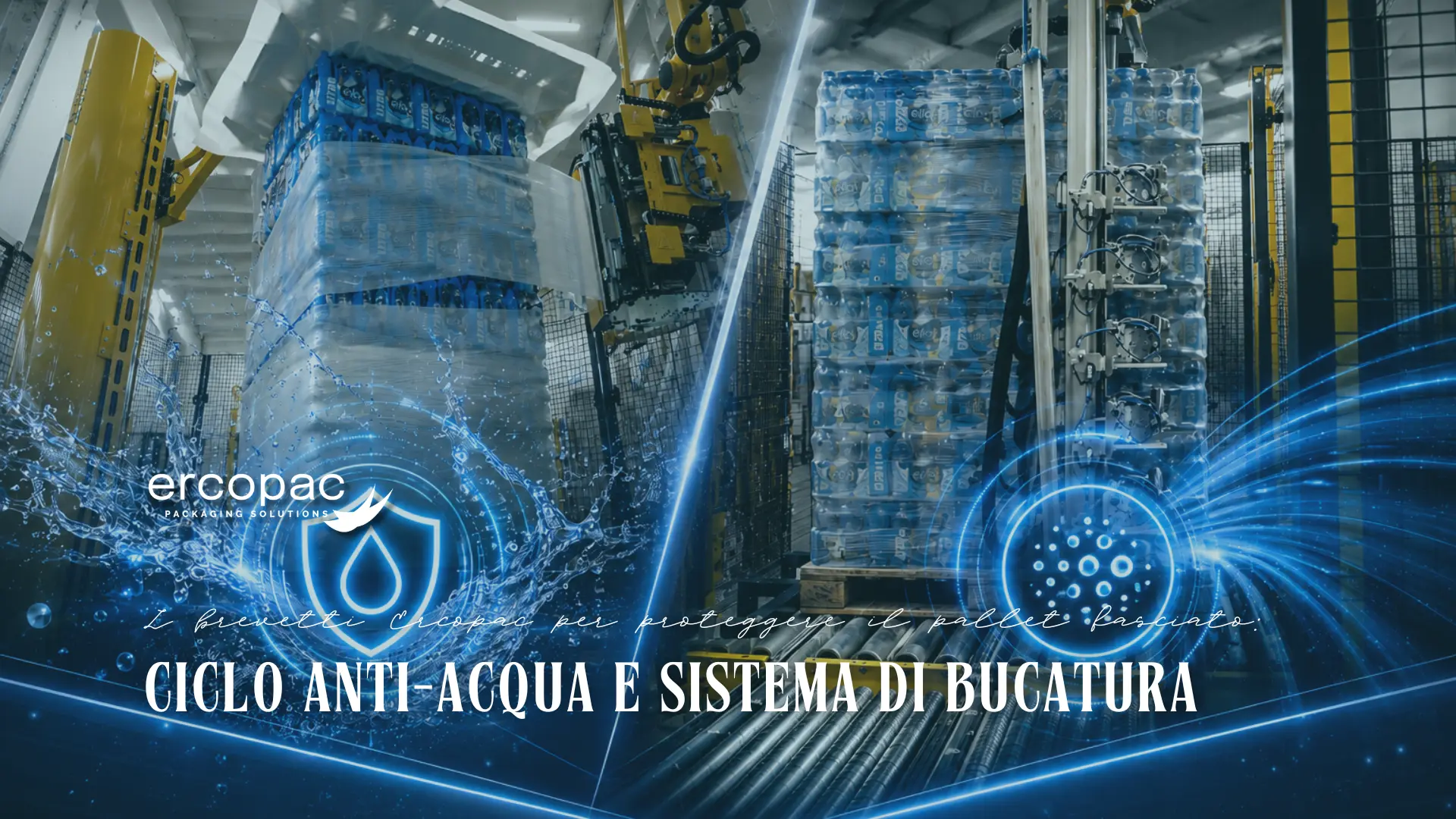
Ercopac has approached film minimization from the opposite direction compared to a “cut and hope” strategy. Instead of simply reducing the amount applied, the company has worked on how film is distributed across the pallet and on enabling the film to do more with less. The result is a system combining three closely related technical elements.
The 750 mm roll. The market standard for stretch film is a 500 mm roll. Ercopac uses 750 mm rolls, a format that substantially changes the geometry of wrapping. A wider roll covers more of the pallet with each revolution, but the more important benefit is how overlaps are distributed. During wrapping, the 750 mm roll allows an optimal diagonal wrap pattern. This produces even film overlap between layers, high stability and proper film distribution across the pallet, without the outer edges of the film deforming the product.
A 500 mm roll, by contrast, needs many more overlaps to cover the same area. This increases film consumption and can concentrate too many turns in the same places. With a 1,000 mm roll, excessive overlap develops at the center of the pallet, increasing consumption without adding stability. The 750 mm roll makes it possible to achieve the correct diagonal pattern, optimizing consumption without sacrificing load integrity.
A further practical advantage is operating autonomy: 750 mm rolls can weigh between 24 and 70 kg, significantly reducing the frequency of roll changes and the associated line downtime.
Electronic pre stretch up to 500%
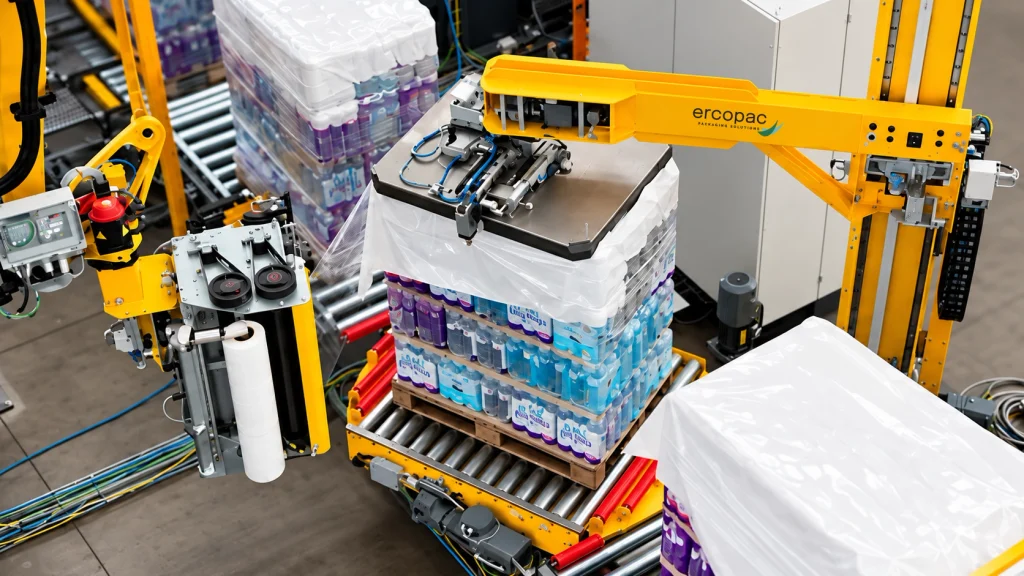
Pre stretch is the process of stretching film before it is applied to the pallet. Ercopac wrappers control pre stretch through two rollers turning at different speeds: the faster roller stretches the film before it reaches the pallet. Precise electronic control allows up to 500% pre stretch. According to the article, this means that one meter of film provides up to five meters of effective coverage on the pallet.
The film retains its containment properties thanks to the polymer’s plastic memory: it is pulled to the limit of its elastic range, where it still has holding force but does not shrink further and deform the products. Unlike conventional mechanical control, electronic control maintains consistent, controlled pre stretch throughout the wrapping cycle, eliminating variations that would leave some areas too tight and others too loose.
Ultra thin film from 11 to 45 microns
The combination of a 750 mm roll and electronic pre stretch up to 500% makes it possible to use very thin films, from 11 to 45 microns. Such films would break under tension in conventional wrapping systems. With Ercopac wrappers, they operate reliably and continuously. The system can also use recycled film with high performance, a relevant factor for both PPWR compliance and corporate sustainability policies.
Compared with ring or rotary arm systems, an additional advantage of a column or robotic wrapper with a top press and turntable on a mechanical axis is its ability to create pronounced diagonal wrap patterns during the cycle. These are essential for greater product stability and optimal film distribution, which ring systems cannot guarantee.
Less film the same protection: What changes in production
Optimizing pallet stretch film with a 750 mm roll and electronic pre stretch brings tangible, measurable benefits on the line. Material consumption falls for each wrapped pallet. Fewer roll changes mean fewer stops and operator interventions. It also eliminates the risk of deforming the unit load through excessive film overlap in the same spots, a frequent problem with 500 mm rolls on stacked pallets.
For those who must meet PPWR obligations, this approach has another advantage: the reduction can be technically documented and justified. It results from optimizing the process with precise, controlled parameters, rather than loosening the wrap. That distinction matters when completing a Declaration of Conformity or responding to a sustainability audit.
Pallet stretch film: How much can be saved according to the data
It is useful to discuss film optimization, but having figures showing what happens when a conventional system is replaced with a Spider system are more useful still.
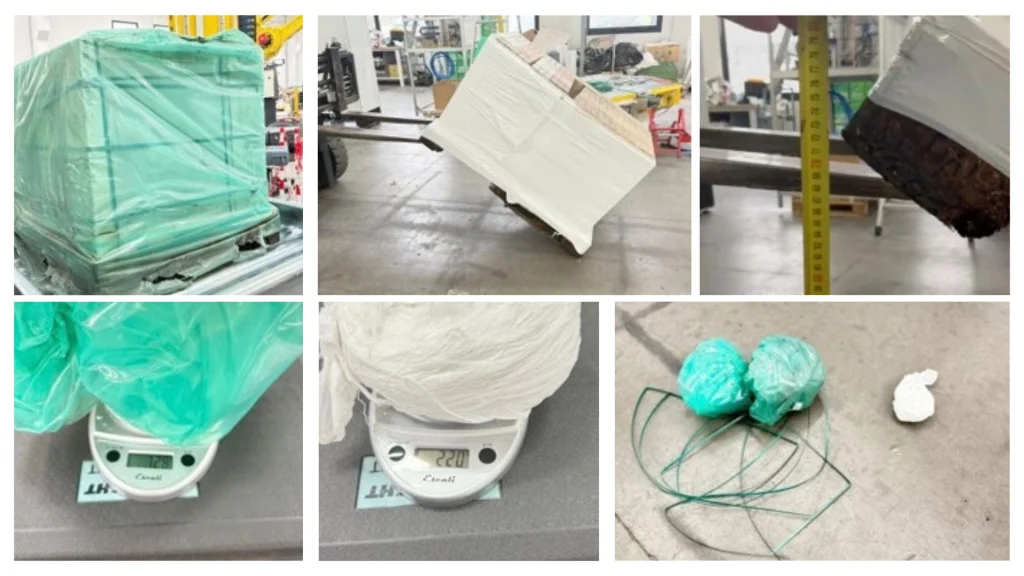
Ercopac conducts film tests directly on customer lines, systematically measuring the weight of film used to wrap a pallet in its current configuration and then the same pallet rewrapped with Spider. It also performs dynamometer tests to measure containment force at the top and bottom of the pallet, including the area most vulnerable to failure in transport. The comparison is made on the same pallet, with the same variables, under controlled conditions.
Results from a test with a representative customer show a recurring pattern: the customer’s pallet had lower containment force and inadequate structural stability. With Spider, using 23.3% less film, average containment force was 60% higher. Specifically, the force at the top increased from 10.4 kg to 14.42 kg, and the force at the bottom from 13.12 kg to 23.59 kg. Film weight fell from 297 grams to 230 grams per pallet.
A second case involved a pallet of tiles packed with two heat shrink hoods and four horizontal straps. The change was substantial: from 1.5 kg of shrink film to 280 grams of stretch film plus top film, and from four straps to one. The material saving is considerable. Eliminating heat shrinking also removes an entire energy consuming step from the process while maintaining the same assurances of water resistance and load stability.
A common feature of these tests is real time monitoring of film weight during the wrapping cycle, with an accuracy of 1–2 grams per pallet. This is what makes the film reduction rigorously documentable, pallet by pallet, and therefore defensible in a PPWR Declaration of Conformity. Rather than claiming to have reduced film use, the operator can demonstrate it with data recorded in every cycle.
The system also passed a tension test on loads containing sharp edged products and an inclined load stability test at 40 centimeters using 100 grams of film. These are conditions frequently encountered in real logistics, which poorly applied thin film cannot withstand.
The starting point: Analyze the process before changing the film
Before changing the type of film or roll format, the most useful step is to analyze the existing wrapping process: the number of turns per pallet, tension, pre stretch, the number of damaged products leaving the line and the number arriving damaged at their destination. Process data already reveal a great deal about where film is being wasted and where there may be too little of it.
If you would like to carry out this analysis on your line, contact us. Together, we can assess your current parameters and show you where and how to optimize film consumption while meeting PPWR requirements without compromising pallet stability.